
Emotional Availability: What It Is And Why It Matters
Every woman deserves to feel emotionally safe—with herself and with others. But emotional availability isn’t just about being open in relationships. It’s about being present with your own feelings, honoring your needs, and allowing space for healing. For many women, this kind of availability has been buried under years of over-functioning, people-pleasing, or simply surviving.
This article is a gentle invitation to reconnect—with your heart, your truth, and your worth. Whether you’re just beginning to explore your emotional landscape or you’ve been on a healing journey for years, these insights will help you deepen your self-awareness and reclaim your emotional power.

What Emotional Availability Really Means
Emotional availability is the ability to be present with your emotions—without judgment, avoidance, or shame. It’s not about being endlessly expressive or “always okay.” It’s about being honest with yourself, willing to feel, and able to communicate your needs with clarity and compassion.
It means:
- You can name what you’re feeling, even when it’s messy.
- You allow yourself to receive love, support, and rest.
- You set boundaries that protect your emotional energy.
- You show up for yourself, even when others don’t.
- You give yourself permission to feel without rushing to fix or hide.
Being emotionally available doesn’t mean you’re always calm or composed. It means you’re willing to be real—with yourself first. That’s where healing begins.
For a deeper look at how emotional availability supports relationships,Psychology Todayoffers a helpful breakdown.
Signs of Emotional Unavailability
Many women don’t realize they’ve become emotionally unavailable to themselves. It’s not always obvious. It can look like:
- Numbing out with busyness, scrolling, or overthinking
- Avoiding vulnerability or emotional conversations
- Feeling disconnected from your body or intuition
- Saying “I’m fine” when you’re anything but
- Over-functioning in relationships while neglecting your own needs
- Feeling guilty for resting or expressing emotion
These patterns aren’t flaws—they’re protective. They often form in childhood or through trauma, when emotional safety wasn’t modeled or supported. But healing begins when you gently start to notice them and offer yourself compassion instead of criticism.
If you’re navigating emotional wounds, you may also want to exploreSigns of Depression and Paths to Healingfor insight and support.

Why Emotional Availability Matters
When you’re emotionally available to yourself, everything shifts. Living from truth replaces the need to perform or please. You no longer abandon yourself to meet others’ expectations. Instead, your choices begin to flow from clarity and self-trust—not fear.
Here’s why it matters:
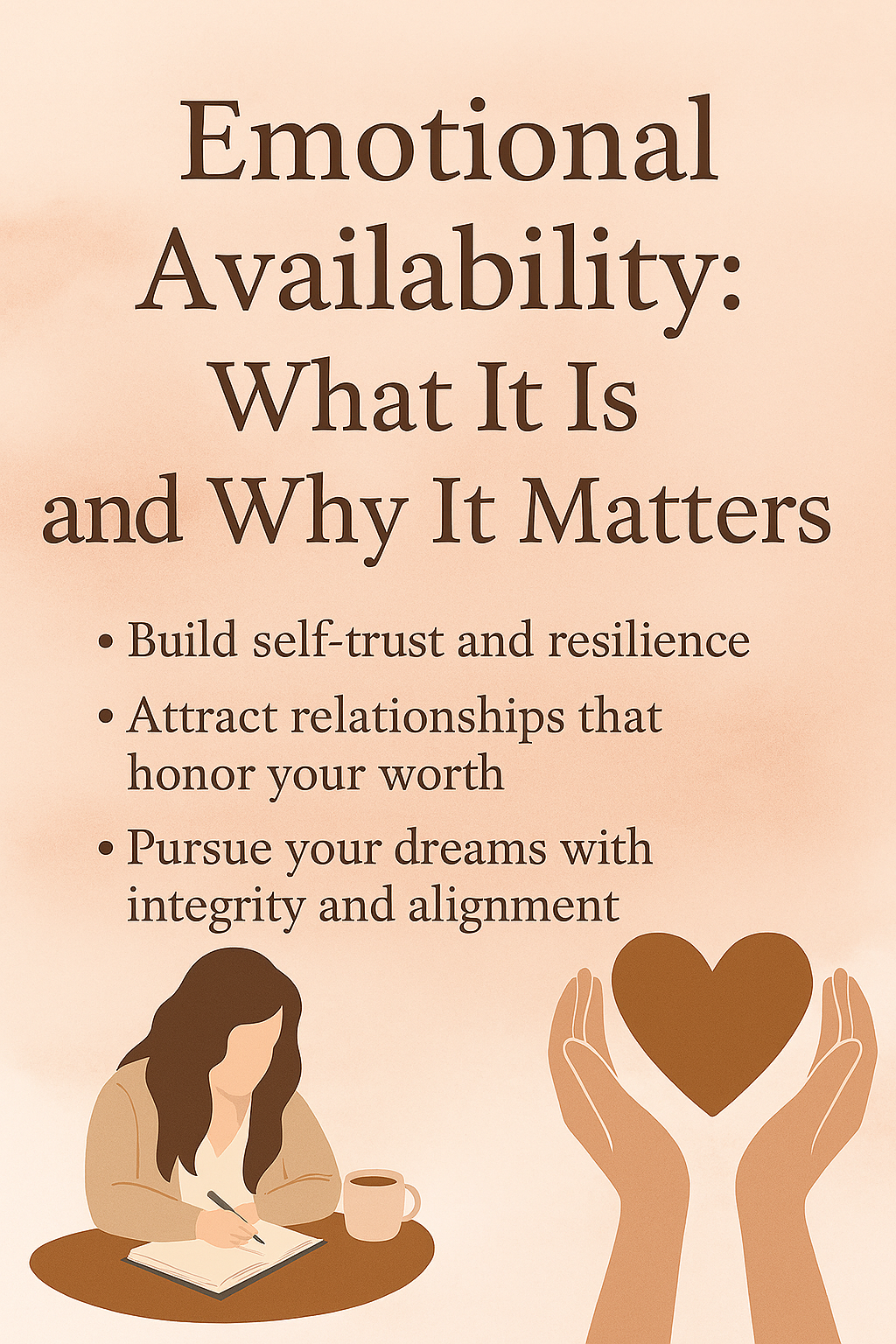
- You build self-trust and emotional resilience
- You attract relationships that honor your worth
- You pursue your dream with integrity and alignment
- Invite space for healing, growth, and joy.
- You stop outsourcing your emotional safety to others
Emotional availability is the foundation ofself-worth, healthyboundaries, and purpose-driven living. It’s the soil where your healing—and your dream—can grow.
When you’re emotionally available, you’re able to hold space for your own complexity. You don’t need to be perfect. You just need to be present.
How to Become More Emotionally Available
This isn’t about fixing yourself. It’s about returning to yourself. Emotional availability is a practice—a relationship you build with your inner world. Here are gentle ways to begin:
1. Name Your Feelings
Start with simple language: “I feel overwhelmed,” “I feel unseen,” “I feel hopeful.” Naming your emotions helps you process them and reduces shame. You can use tools like theSelf-Love Daily Checklistto track and honor your emotional state.
2. Pause Before Reacting
Instead of reacting out of habit or urgency, give yourself a moment to breathe and choose a response that reflects your truth. That pause creates space for clarity, compassion, and alignment. Take a breath. As you prepare to speak or act, allow space to notice what you’re truly feeling. By tuning into what you’re truly feeling, you create space for more honest and aligned responses.This builds emotional clarity and self-trust.
3. Set Boundaries That Protect Your Energy
Boundaries aren’t walls—they’re clarity. They help you stay emotionally safe and available to yourself. Practice saying no without guilt. Honor your limits. For practical guidance, readHow to Set Boundaries Without Guilt.
4. Practice Receiving
Let others support you. Let rest be enough. Emotional availability includes being open to love, help, and softness—not just giving endlessly. When receiving feels unfamiliar or uncomfortable, begin with gentle steps. For example, you might welcome a compliment without deflection, ask for support even in small ways, or allow yourself to rest—without needing to explain why.
5. Use Supportive Tools
Journaling, therapy, breathwork, or guided meditations can help you reconnect. You might exploreBetterHelpfor online therapy options or use apps like Insight Timer for emotional grounding.
6. Reconnect With Your Body
Emotions live in the body. Gentle movement, grounding exercises, and mindful breathing can help you feel more present and emotionally attuned. Practices like yoga, somatic therapy, or even walking in nature can support this reconnection.
7. Celebrate Progress, Not Perfection
Emotional availability grows over time. Celebrate small wins—like naming a feeling, setting a boundary, or choosing rest. These moments matter. They’re proof that you’re showing up for yourself.
Closing Reflection
Emotional availability isn’t a destination—it’s a relationship. One you build with yourself, moment by moment. Because you are worthy, you deserve to feel seen, heard, and held—not only by those around you, but most importantly by your own heart.
As you grow emotionally available, your dream begins to feel more attainable. Your boundaries become clearer. Your healing deepens. And your life begins to reflect the truth of who you are.
You don’t need to be perfect to be emotionally available. You just need to be willing. Open to feeling. Ready to listen. Committed to showing up for yourself with love.


Kiersti writes on self-love and personal development professionally. Over the past ten or so years, she has studied self-love and personal growth. Visit https://womansdailyneeds.com/ to learn more about what she does, and like her on Facebook at https://facebook.com/womansdailyneeds to keep up with her.
8 Responses
As someone who has worked in healthcare for over 20 years, this really struck a chord with me. I’ve spent most of my adult life caring for others: patients, colleagues, even family, and somewhere along the way, I convinced myself that I didn’t need much care in return. I’ve fallen into that habit of saying “I’m fine” even when I’m clearly not, and reading your words about emotional availability reminded me how deeply that pattern can affect both personal well-being and relationships.
How would you suggest someone in a caregiving profession begin to shift from always putting others first to learning how to open up emotionally without feeling guilty or selfish?
That kind of emotional honesty takes courage, and it’s the first step toward healing. For someone in a caregiving profession, shifting from always putting others first begins with reframing vulnerability as a strength—not a weakness. Emotional openness isn’t selfish; it’s a way to sustain your capacity to care. Start by sharing small truths with safe people, practicing self-check-ins, and gently interrupting the guilt narrative with compassion: you deserve the same care you so freely give. Receiving support doesn’t diminish your role—it deepens your humanity within it.
Thank you for the tips on becoming more emotionally available. I think this will help me a lot if I permit myself enough time to work through them.
I need to work on becoming more open to support and help as well as love, as I feel that sometimes I try to do everything myself, instead of asking for the help I need, as I feel guilty that I am putting others out. Celebrating the small wins is also important. I am going to join a yoga class next week and take it from there.
That sounds like such a meaningful step forward—joining a yoga class is a beautiful way to reconnect with yourself and practice receiving. I totally relate to that guilt around asking for help; it’s something I’ve had to unlearn too. Giving ourselves permission to be supported is part of emotional availability, and it doesn’t make us a burden—it makes us human. Cheering you on as you celebrate those small wins and take this next step with intention.
Emotional availability is such an important yet misunderstood topic, so I loved how you broke it down here. Your definition of being present with your feelings and communicating your needs without shame really resonated with me – it’s not about being endlessly expressive but about being honest with yourself. I’ve definitely fallen into some of the unavailability signs you listed, like numbing out with busyness or scrolling, and it’s comforting to remember those patterns are protective rather than flaws. The section on why it matters made me realise how much self‑trust, resilience and healthy boundaries come from honouring our own emotions instead of performing for others. I appreciate your gentle suggestions like naming feelings, pausing before reacting, setting boundaries, practising receiving and celebrating small wins; they feel doable instead of overwhelming. Do you have any go‑to tools or practices for reconnecting with your body when you feel disconnected? Thanks for this empowering reminder that being emotionally available to ourselves is a practice, not a destination.
Thank you—that means a lot. I’ve definitely used busyness and scrolling to disconnect, and it’s comforting to remember those patterns are protective, not flaws. Your reminder that emotional availability is a practice really hit home. For reconnecting with my body, I’ve found grounding exercises, slow movement, and even just placing a hand on my heart and saying “I’m here” can help me feel more present.
When I was young I was not emotional available to my partner or myself, so that eventually split us apart after 20 years. I experienced most of the ones that you share when you are not emotional available, I was not honest with myself or my partner most of the time.
Your section on how to be ready is an awesome guide, I only wish I had known all that you shared when I was young and still in a relationship.
Jeff
Thank you for sharing that, Jeff. It takes a lot of courage to reflect so honestly on the past, and your words carry so much wisdom. I really believe emotional availability is something we learn over time—often through the very experiences that challenge us most. I’m grateful the guide resonated with you, and I hope it serves as a gentle reminder that growth doesn’t have an expiration date. Your insight will no doubt help others feel less alone in their own journey.